Advancing Awareness, Research, and Diagnosis in Telomere Biology Disorders
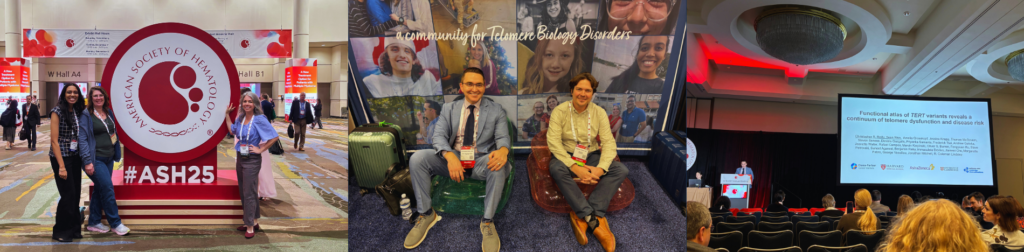
Team Telomere attended the 2025 American Society of Hematology (ASH) Annual Meeting, where we represented the Telomere Biology Disorder (TBD) community on the global stage. ASH brings together tens of thousands of clinicians, researchers, and industry partners focused on blood and bone marrow diseases. We engaged with investigators leading cutting-edge science, raised awareness about the importance of telomere length and genetic testing, and shared perspectives to keep patient needs at the center of research and care. The highlights below summarize key sessions most relevant to families affected by Telomere Biology Disorders.
Scientific Workshop on Germline Predisposition to Hematopoietic Malignancies and Bone Marrow Failure
Clinical Indications and Diagnostic Yield for Telomere Length Testing For 8,364 Patients Over 8 Years in a US-Based Reference Lab
One major presentation reviewed 8,364 patients who had flow FISH telomere length testing over an eight-year period in a large U.S. reference laboratory. They showed data that clinical testing has increased steadily since 2017. The most common reasons testing was ordered were: pulmonary fibrosis (scarring of the lungs) and benign blood problems (such as low blood counts). Together, these two reasons accounted for over 70% of all testing. Age patterns differed by condition. People tested for blood problems tended to be younger, with a median age of 18 years, while those tested for pulmonary fibrosis had a median age of 66 years. Among patients with blood disorders who received telomere length testing, about 10% had telomere lengths shorter than the 1st percentile in lymphocytes, and among those with pulmonary fibrosis, about 5% had telomeres shorter than the 1st percentile.
Genetic And Clinical Landscape of Cytopenia in Adults with Late-Onset Telomere Biology Disorders and Interstitial Lung Disease
This presentation looked at adults with late-onset telomere biology disorders and examined how often they developed problems with their blood or bone marrow. The researchers described the frequency and types of cytopenias (low blood counts) seen in these patients and reviewed what their bone marrow samples looked like under the microscope. They studied the genetic changes that blood and bone marrow cells develop over time, identifying characteristic patterns of somatic variants that seem to be common in people with TBDs.
Discovering the Biology of Hematopoiesis Through Studies of Bone Marrow Failure Syndromes
This session focused on how studying inherited bone marrow failure syndromes helps scientists understand how blood is normally made, why it goes wrong, and how these changes connect to aging and cancer. It is important to study genetic conditions because they act like “windows” into basic biology. By better understanding what happens when certain genes are disrupted, researchers can better learn about how healthy bone marrow works. The speakers covered several major themes including the cell’s protein-building machinery (ribosomes), telomeres, and natural chemicals in the body (aldehydes).
Dr. Luis Batista focused on the link between telomerase, bone marrow health, and bone marrow failure. Telomerase is the enzyme that helps maintain telomeres. He explained that recent research has shown that the RNA part of telomerase (called hTR) must be carefully processed and protected inside the cell so that it does not break down quickly. When this RNA is unstable, telomerase cannot do its job, telomeres shorten, and the function of bone marrow cells may be impacted. These pathways can potentially be targeted with future therapies. By preventing the breakdown of hTR, it may be possible to improve telomerase activity, which may stabilize telomeres and improve blood cell production.
The Emerging Landscape of Germline Predisposition to Bone Marrow Failure and Leukemia
This session focused on how inherited genetic changes can increase a person’s risk for bone marrow problems and blood cancers. As more people have their genes tested clinically and in large research studies, doctors and scientists are realizing that inherited risk is more common than we once thought. Dr. Lisa Reynolds talked about what is currently known about the genes that can cause inherited bone marrow failure and increase leukemia risk. The talk highlighted studies that look at large groups of people from the general population, not just those already diagnosed, to understand how common these genetic changes really are. She also discussed implications for screening, counseling, and follow-up care when these genetic changes are found. Dr. Coleman Lindsley discussed how bone marrow cells with inherited risk can acquire additional genetic changes over time. This can lead to clonal hematopoiesis (where a mutated blood stem cell expands) and leukemia. Understanding these links is helping clinicians diagnose conditions earlier, guide monitoring, and better estimate who may be at higher risk for bone marrow failure or leukemia.
Bone Marrow Failure and Cancer Predisposition Syndromes: Congenital: From Inheritance to Innovation
The Bone Marrow Failure and Cancer Predisposition Syndromes: Congenital – From Inheritance to Innovation session highlighted emerging science at the intersection of genetics and clinical outcomes in inherited marrow failure syndromes. Six talks were presented on advances across Fanconi anemia, Diamond-Blackfan anemia, Shwachman-Diamond syndrome, severe congenital neutropenia, and Telomere Biology Disorders. The talk most pertinent to TBDs was titled “A continuum of inherited telomere dysfunction links TERT rare variants to age-related diseases”, presented by Dr. Christopher Reilly, from Dana-Farber Cancer Institute.
A continuum of inherited telomere dysfunction links TERT rare variants to age-related diseases – Dr. Christopher Reilly, Dana-Farber Cancer Institute
Telomere Biology Disorders (TBDs) are clinically rare. However, rare TERT missense variants are common in the general population, on the order of one in twenty individuals. Most of these variants are “variants of uncertain significance”, which are changes in a gene’s DNA where we do not yet have enough information to know if it’s harmful (pathogenic) or harmless (benign). This discrepancy between the rarity of TBDs and the high prevalence of TERT variants raises the question: are TBDs possibly the most severe end of a much broader spectrum of telomere problems that affect more people?
To answer this question, researchers studied hundreds of thousands of participants in a database called the UK Biobank. They first identified people with rare TERT gene changes. In order to assess the impact of the variants, they developed a test (a cell-based assay) to see the impact that the genetic change had on telomere extension compared to baseline.
This functional testing allowed them to classify variants into four groups, ranging from minimally impaired to most severely impaired. Of importance, the distributions of TERT activity for clinically recognized TBD-associated variants and population variants overlapped, showing that variants in the population database still had meaningful functional consequences. The researchers then connected these functional groups to real-world biology and clinical outcomes. Increasing severity of TERT impairment was strongly associated with shorter measured telomere length in participants. Clinically, the gradient of TERT impairment also translated into a gradient of disease risk. More severe variant groups displayed higher rates of TBD-associated phenotypes, including fibrotic interstitial lung disease, bone marrow dysfunction, specific patterns of clonal hematopoiesis (genetic changes in blood stem cells), aplastic anemia, and osteoporosis with pathological fracture. In survival analyses, individuals in the most severe impairment group exhibited an increased risk of all-cause mortality.
Overall, prevalence of functionally impaired TERT rare missense variants is much higher than previously recognized with functional effects that exist along a continuum of dysfunction. This work reframes TBDs as an extreme end of a much broader spectrum that shapes telomere length and disease risk.